Orchid Floral Seamless Background Pattern
A Designer’s First Look: Delicate, Lush, and Quietly Confident
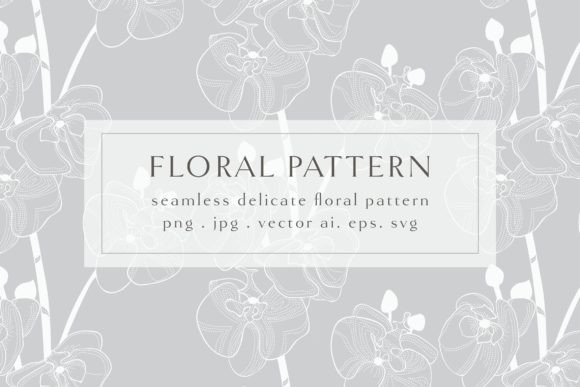
When I opened Orchid Floral Seamless Background Pattern, my first thought wasn’t “pretty”—it was “breathable.” That’s rare for a floral background. The orchids aren’t shouting; they’re leaning in—curved stems, soft petal edges, gentle spacing that lets negative space do half the work. It feels like wrapping tissue paper: light, intentional, and quietly luxurious. This isn’t a bold statement pattern—it’s a whisper of elegance that supports rather than overwhelms. As a designer who’s stitched hundreds of client projects—from boutique aprons to personalized baby blankets—I immediately pictured it on a linen tea towel or the back panel of a structured cotton tote. Not as a focal point, but as the quiet confidence behind a monogram or small embroidered motif.
Where It Shines in Real Embroidery Projects
I tested Orchid Floral Seamless Background Pattern across three real-world uses: a custom embroidered sweatshirt for a local florist’s staff, a set of nursery pillow covers for an Etsy seller, and a limited-run batch of holiday gift tags printed *and* stitched as embroidered patches. In each case, the pattern held up—not just visually, but functionally.
- Custom apparel: On midweight French terry, the orchids read clearly without puckering—even at a modest 4" x 4" repeat. The seamless flow meant no awkward breaks at side seams or sleeve hems.
- Baby embroidery: Paired with a simple satin-stitched name on organic cotton swaddle cloth, the background added heirloom softness without competing for attention. Parents consistently commented on how “calm” and “thoughtful” the finished product felt.
- Embroidered patch: When digitized as a 3.5" circular patch (with clean edge finishing), the design retained its delicate balance—no overcrowded fill stitch zones, no thread nests in tight curves. That’s not accidental; it signals thoughtful vector construction.
It also translated well into printable mockups for Etsy sellers—the seamless repeat made it easy to show scale variations on everything from cap brims to kitchen towels without visible tiling artifacts.
Where to Proceed with Care
This pattern is graceful—but grace requires intention. It’s not a “throw-it-on-anything” graphic. Here’s where I slow down:
- Small hoop sizes: Below 3" wide, some orchid details (especially slender stamens and fine petal veining) risk becoming indistinct. Test stitch density first—you may need to simplify or adjust underlay.
- Textured or stretchy fabric: On slubbed linen or lightweight knits, the delicate lines can blur if stabilizer choice isn’t precise. A medium-weight cutaway + tear-away combo worked best in my tests.
- Dark fabric backgrounds: The original palette leans pastel—lavender, mint, pale peach. On charcoal or navy, those colors recede unless you swap in higher-contrast threads (e.g., deep plum instead of lilac). Always test a black-and-white mockup first.
- Curved surfaces: Caps and curved pillow edges pulled subtle distortion in the outermost repeats. I recomposed the layout to center the strongest orchid cluster—not the full tile—and trimmed excess repeat for cleaner drape.
What It Adds to Your Handmade Product—Beyond Aesthetics
Orchid Floral Seamless Background Pattern elevates more than just visuals. It quietly reinforces trust. Customers browsing a handmade shop notice when background elements feel considered—not filler. That matters whether you’re selling a $28 embroidered tea towel or a $145 bridal robe. The pattern reads as “designed,” not “downloaded.”
For craft business owners, it strengthens brand consistency: imagine using the same seamless repeat across your packaging tissue, shop banner, and product labels—then stitching a scaled-down version onto a matching apron. That cohesion builds recognition faster than any logo alone. And for personalized gifts? Its subtlety makes it ideal for recipients who prefer meaning over flash—think graduation caps for botany majors, anniversary napkins for gardeners, or hospice care blankets where visual calm is part of the healing.
Practical Notes Every Embroidery Designer Should Check
Before cutting fabric or uploading to your machine:
- Test on scrap first—not just for stitch-out, but for how the pattern interacts with your chosen stabilizer and thread tension.
- Review stitch density. Dense fill areas can stiffen lightweight fabrics; running stitch accents in the stems help break up weight.
- Confirm hoop size compatibility. Seamless doesn’t mean infinitely scalable—check the largest recommended repeat dimension before resizing.
- Inspect small details at 200% zoom in your embroidery software. Are petal tips cleanly terminated? Do inner loops have enough underlay?
- Compare light/dark fabric mockups—both digitally and physically. What reads as “soft” on ivory may vanish on oatmeal.
- Verify licensing for your use case. Since this is a Graphics-type Patterns asset, confirm whether commercial embroidery (e.g., selling finished embroidered totes) or digital resale (e.g., bundling with your own embroidery file) is permitted.
Final Thought: A Background That Behaves Like a Collaborator
Most seamless patterns either dominate or disappear. Orchid Floral Seamless Background Pattern does neither. It holds space—giving your primary embroidery motif room to land, your brand voice room to resonate, and your customer room to feel seen. It’s the kind of design that makes people pause, tilt their head, and say, “This feels *made*.” Not mass-produced. Not trend-chasing. Just quietly, confidently right for the project at hand. Whether you're stitching a single holiday gift or scaling a small shop product line, that kind of intention is the difference between “nice” and “unforgettable.”