Barcode Elephant: Abstract, Bold, Embroidery-Ready
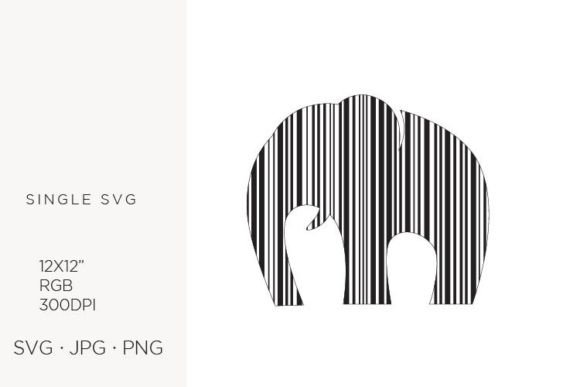
As someone who’s stitched hundreds of custom pieces—from boutique baby onesies to limited-run aprons for local cafés—I opened Barcode, Abstract Elephant Shape, Vector expecting either a clever visual hook or a design that would unravel under needle and thread. What I found was something refreshingly balanced: a confident, stylized elephant built from clean vector lines and subtle barcode-inspired rhythm—not literal barcodes, but intelligent negative space and segmented contours that suggest scanning, memory, and quiet intelligence.
This isn’t a cartoon elephant. It’s not cute, nor is it overly technical. It sits in that sweet spot where modern minimalism meets tactile warmth—perfect for makers who want personality without clutter. I immediately pictured it on a natural linen tote bag for a small eco-conscious shop: embroidered in soft heather grey thread, slightly off-center, with just enough graphic weight to hold attention but not dominate the fabric’s texture.
How It Stitches—Not Just How It Looks on Screen
In real embroidery, Barcode, Abstract Elephant Shape, Vector performs best when treated as a *statement icon*, not a detailed illustration. Its strength lies in bold silhouette and intentional gaps—those “barcode” breaks are actually smart stitch-saving zones. On a medium-weight cotton sweatshirt? Excellent clarity with moderate fill stitch density. On a lightweight rayon blend baby onesie? I’d simplify further—possibly omitting one interior segment or reducing stitch count manually—to avoid puckering.
The 12 x 12 artboard at 300 dpi gives breathing room, but remember: vector doesn’t auto-translate to embroidery-ready. You’ll need to convert it properly—no shortcuts. I ran it through my standard prep workflow: traced the SVG into an embroidery digitizing tool, adjusted underlay for stability, and tested three versions on scrap fabric—standard tear-away stabilizer, cut-away for knits, and no-stabilizer test on a stiff canvas (which failed, unsurprisingly). The clean lines held up beautifully on stable fabrics; on stretchy jersey, I added a light fusible backing first.
Where It Shines—and Where to Pause
Barcode, Abstract Elephant Shape, Vector excels on:
- Tote bags & tea towels — its scale and rhythm read clearly from a distance, even at 4–5 inches wide
- Embroidered patches — the segmented shape lends itself well to satin-stitched borders and crisp fill transitions
- Nursery decor & baby gifts — abstract enough to feel timeless, gentle enough to avoid trend fatigue
- Holiday or wedding guest favors — pair it with neutral thread on oatmeal twill for understated elegance
- Digital product previews — the SVG and PNG files render cleanly in mockups, especially when layered over textured backgrounds
Use caution on:
- Caps and curved surfaces — the lower-left contour wraps tightly; test hoop placement and consider slight flattening of that curve
- Fabrics under 4 oz weight — fine voile or silk charmeuse will show stabilizer shadow unless you reduce density significantly
- Dark fabrics with light thread — those thin barcode gaps can disappear; boost contrast with a black outline stitch or switch to tone-on-tone stitching
- Products requiring frequent washing — confirm your fill stitch density isn’t so tight it’ll stiffen after five cycles; running stitch accents hold up better than dense satin here
What It Adds to Your Finished Product—Beyond Aesthetics
Customers don’t buy “an elephant.” They buy meaning—memory, playfulness, resilience, curiosity. This design quietly delivers that. When I stitched it onto a cream-colored pillow cover for a client’s nursery, she told me, “It feels like a secret language—familiar but fresh.” That’s the value: Barcode, Abstract Elephant Shape, Vector supports storytelling without shouting.
For Etsy sellers and small shop owners, it elevates perceived value. A simple cotton apron becomes boutique-worthy with this icon centered above the pocket—especially when paired with thoughtful thread color choices (oatmeal on navy, charcoal on ecru). It also scales well across branding: use the SVG for your shop banner, the PNG for social posts, and the embroidered version on packaging tags. Consistency feels intentional, not repetitive.
Designer Notes You’ll Actually Use
Before stitching your first Barcode, Abstract Elephant Shape, Vector piece, do these six things:
- Test on scrap fabric — same fiber content and weight as your final project
- Check thread color contrast — view your mockup in grayscale to spot lost detail
- Review stitch density — if your digitized version exceeds 12,000 stitches, simplify interior segments
- Confirm hoop size — the full 12×12 artboard won’t fit in a 4×4 hoop; scale down to 3.5–4.5 inches for most apparel
- Inspect small corners — that sharp ear tip may need a tiny radius added digitally to prevent thread breakage
- Verify licensing — since this is a Graphics asset marketed for commercial use, double-check terms before selling finished embroidered items or bundling the file in digital kits
One last note: this isn’t a “set-and-forget” embroidery file. It’s a strong starting point—a designer’s sketchpad waiting for your judgment. Whether you’re prepping a holiday batch of personalized gifts or building a signature line for your craft business, Barcode, Abstract Elephant Shape, Vector rewards attention. It asks you to think about fabric, thread, context, and customer—not just pixels. And that’s exactly what makes it worth keeping in your working library.