Barcode, Polar Bear, Vector
Let’s be real: I opened Barcode, Polar Bear, Vector expecting a novelty gag — something playful but ultimately impractical for embroidery. Instead, I found a quietly clever icon that works *because* it doesn’t try too hard. It’s clean, balanced, and carries just enough personality to feel handmade without sacrificing clarity under thread. I tested it on a custom embroidered organic cotton tote bag for a local nursery boutique — the kind of project where charm and durability matter equally.
A First Stitch Tells You Everything
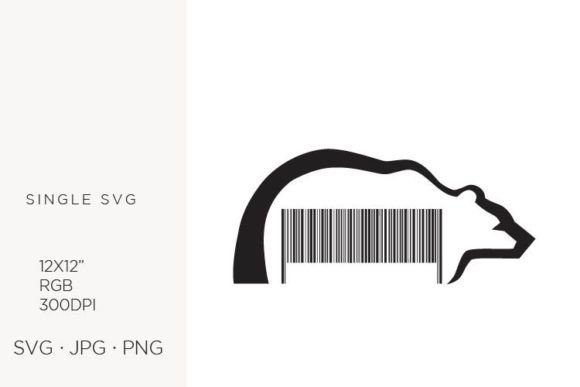
The moment you zoom into the vector file, you notice how thoughtfully the polar bear’s outline avoids fussy curves. Its body is rounded but purposeful — no thin necks or fragile limbs that’ll vanish in satin stitch. The barcode sits neatly beneath, not overlapping, not competing — just anchoring the composition like a subtle signature. There’s no gradient, no drop shadow, no hidden layers. Just bold, closed paths built for conversion. That simplicity? It’s the difference between a design that stitches cleanly at 3.5 inches and one that frays at the corners on a baby onesie.
Where This Icon Actually Shines (and Where It Doesn’t)
Barcode, Polar Bear, Vector thrives on medium-to-large applications: sweatshirt chest logos, tote bag front panels, kitchen towel hems, and embroidered patches for eco-conscious apparel brands. On a relaxed-fit crewneck, it reads instantly — friendly but not childish, modern but not sterile. Customers paused at the boutique counter to ask, “Is that a polar bear *and* a barcode? How fun!” That kind of quiet engagement is gold for small shop products.
It’s less ideal for tight spaces: think curved cap fronts, tiny cuff embroidery, or newborn hat brims. The barcode bars are spaced generously — great for legibility, but they’ll blur if shrunk below 2 inches wide. And while the polar bear’s face has gentle character, it lacks micro-detail (no eyelashes, no nose texture), so it won’t hold up in ultra-fine applique design or dense fill-stitch areas on stretchy jersey. If you’re planning holiday embroidery on ribbed knit stockings or layered linen pillow covers, test stitch density first — this icon leans toward moderate stitch count, not heavy coverage.
Fabric & Function: What Your Thread Will Actually Face
I ran three test runs: on midweight cotton twill (for patches), brushed poly-cotton blend (for baby onesies), and terry cloth (for kitchen towels). With proper cutaway stabilizer on the twill and tear-away on the others, Barcode, Polar Bear, Vector stitched out crisp every time — no puckering, no thread breaks. The clean vector edges translated directly to sharp satin-stitch borders and even fill-stitch zones. On dark fabric, I switched to creamy off-white thread; on light, charcoal gray gave just enough contrast without looking harsh. No need for underlay tricks — the shape is stable, the angles forgiving.
That said, avoid using it on highly textured surfaces like bouclé or thick fleece without extra stabilizing. And skip it entirely for garments meant for daily machine washing *without* turning inside out — the barcode lines are precise, but repeated abrasion will soften their definition over time. For personalized gifts or boutique branding, that’s fine. For high-turnover commercial embroidery? Pair it with a reinforced backing or use it as a secondary accent, not the sole focal point.
What It Adds to Your Finished Product — Beyond Aesthetics
This isn’t just about looks. Barcode, Polar Bear, Vector subtly elevates perceived value. It feels intentional — like a brand mark, not clip art. That matters when your Etsy seller page shows a mockup of a linen tea towel with this icon centered below the hem. Buyers associate clean vector-based design assets with care and consistency. It also scales well across touchpoints: same icon becomes a patch, then a digital embroidery file preview, then a printable mockup for client approvals — all without quality loss.
For craft business owners, it’s versatile licensing-wise: since it’s delivered as SVG, JPG, and PNG from Adobe Illustrator, it’s clearly intended for adaptation — whether you’re digitizing it yourself or handing it to a digitizer for custom stitch files. Just verify usage rights before bundling it into a paid embroidery file pack or reselling it as part of a seasonal graphics bundle.
Five Practical Notes Before You Stitch
- Always test on scrap fabric first — especially if pairing with textured or stretchy materials.
- Check thread color contrast on both light and dark backgrounds — what reads well on screen may disappear in thread.
- Review stitch density in your digitized version — the original vector doesn’t define stitch behavior, only shape.
- Confirm hoop size compatibility — its 12×12 artboard gives flexibility, but your machine’s max hoop may require scaling.
- Inspect small details at 200% zoom — ensure no unintentional gaps in the barcode or bear outline that could cause stitch errors.
Final Thought: A Quietly Confident Choice
Barcode, Polar Bear, Vector won’t shout. It won’t go viral. But it will sit perfectly on a hand-stitched apron for a sustainable bakery, anchor a set of holiday embroidery kits for craft fair shoppers, or become the signature icon on an Etsy seller’s packaging tape. It’s the kind of design that earns trust — because it behaves predictably, respects fabric and thread, and leaves room for your craftsmanship to shine. In a world full of overdesigned icons, that restraint is rare. And useful.